Graffiti, paint markings, stickers, and unauthorized posters placed on walls and building facades can negatively impact a property's appearance, an organization's image, and the overall visual quality of public spaces. For municipalities, public institutions, homeowners' associations, commercial centers, and businesses, prompt removal of these nuisances helps maintain a clean, properly maintained, and welcoming environment.
Graffiti removal is a professional process that requires selecting the appropriate cleaning method based on the surface type, the type of paint used, and the condition of the structure. Using an unsuitable method may damage the surface itself, making it essential to choose a solution that enables effective graffiti removal while preserving the original appearance of the wall, facade, or cladding.
At Tavas, the service is provided by PowerJet, the company's specialized division for cleaning and restoring walls, building facades, and monuments, as well as removing graffiti, markings, unauthorized posters, and various types of surface contamination.
Removal Methods Based on Surface Type
Not every graffiti marking can be removed using the same technique. The type of surface is one of the primary factors that determines the cleaning method and the removal process used.
The appropriate method is selected according to the surface material, the type of paint, the depth of penetration, and the overall condition of the affected area. Graffiti removal services are performed on a wide range of surfaces, including stone, concrete, plaster, metal, glass, and other cladding materials.
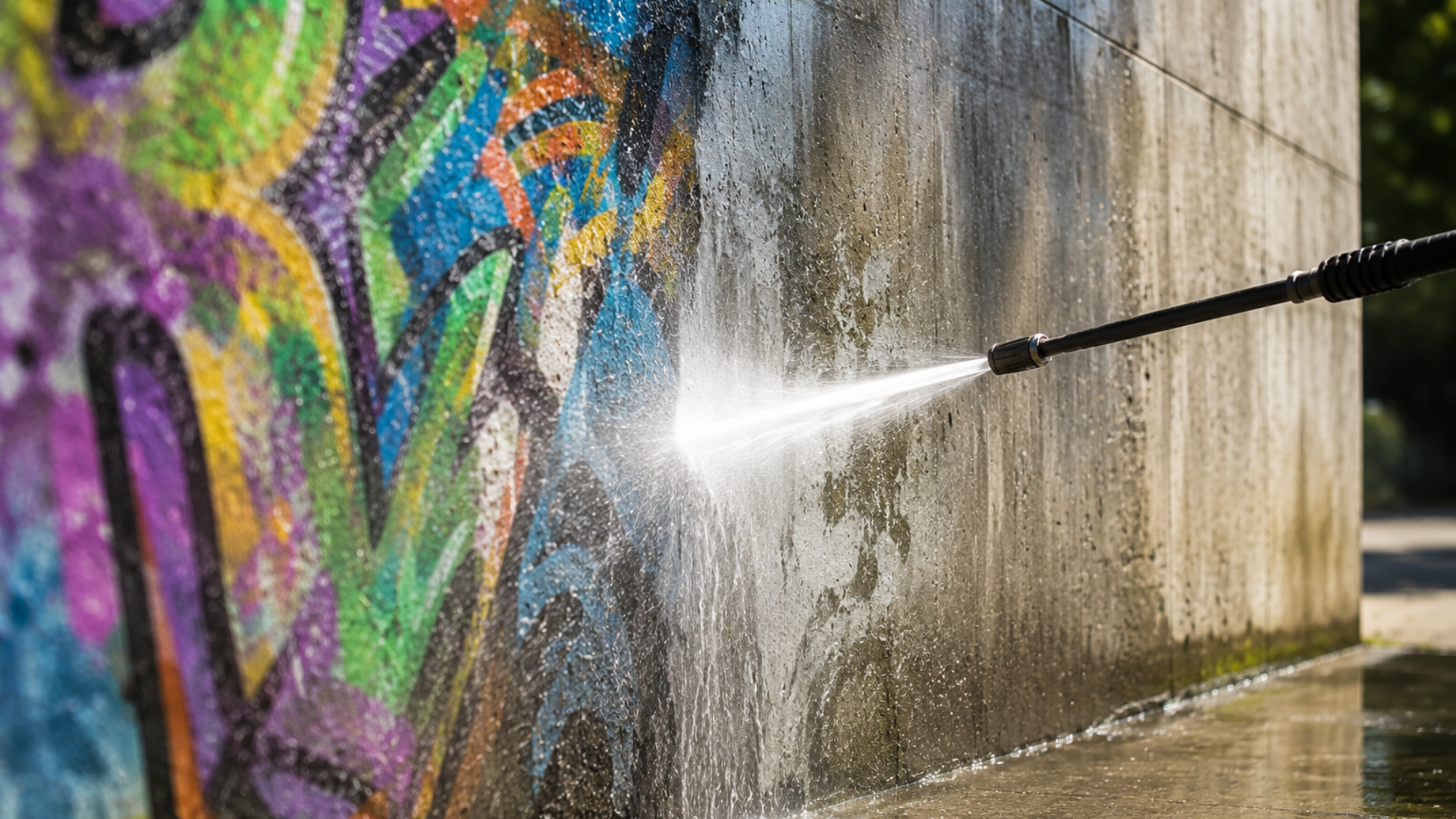
In some cases, graffiti can be removed using specialized cleaning agents. In other cases, high pressure water cleaning or advanced cleaning methods are used to remove paint without damaging the surface.
One of the most common methods in the industry is High Pressure Cleaning, which enables the efficient and controlled removal of dirt, paint, and graffiti from a variety of surfaces. When dealing with thick paint layers or particularly stubborn contamination, abrasive blasting may also be used to remove paint layers and accumulated deposits that have built up over time.
The goal is not only to remove the graffiti, but to do so in a controlled, thorough, and surface-appropriate manner, ensuring that the wall, cladding, or facade retains a clean and professional appearance over time.
Graffiti Removal from Stone and Plaster
Stone and plaster are among the most common surfaces on which graffiti appears. At the same time, they are also relatively sensitive materials, as paint can penetrate their porous structure and make the removal process more challenging.
Removing graffiti from stone walls or plaster surfaces requires careful selection of the appropriate cleaning method. Using overly aggressive chemicals or excessive pressure may damage the surface texture or alter its appearance.
Jerusalem stone, spray plaster, and other cladding materials require professional treatment tailored to the characteristics of the material, with the goal of removing graffiti while preserving the original appearance of the surface.
For this reason, graffiti removal from stone and plaster surfaces is carried out using a combination of specialized cleaning agents, controlled washing techniques, and work methods adapted to the type and condition of the cladding.
When graffiti appears on a building facade, removal work is often performed as part of a broader process of Building Facade Cleaning and overall facade restoration.
Anti-Graffiti Coating
In locations that are repeatedly exposed to graffiti, such as public institutions, educational facilities, municipal buildings, transportation hubs, and commercial complexes, anti-graffiti coatings can be incorporated as part of a long-term maintenance strategy.
An anti-graffiti coating creates a protective layer on the surface, making future graffiti removal significantly easier. Instead of allowing paint to penetrate the material, the coating enables faster and more efficient removal.
In addition to improving graffiti removal capabilities, the coating helps preserve the appearance of the building over time and reduces the need for repeated cleaning and restoration work.
This solution is particularly common in public buildings, commercial centers, transportation facilities, educational institutions, and areas with a high exposure to vandalism.
Services for Municipalities and Public Institutions
Municipalities, local authorities, public institutions, and large organizations regularly deal with graffiti, unauthorized posters, and accumulated dirt on walls, facades, and fences.
In these cases, response time is a critical factor. The sooner graffiti is removed, the lower the likelihood of additional markings appearing in the same location. For this reason, many organizations aim to complete graffiti removal within 24 to 48 hours of receiving a report.
Tavas provides graffiti removal and wall cleaning services for public buildings, hotels, commercial centers, fences, public institutions, and local authorities. The company also removes unauthorized posters and notices placed illegally on walls and building facades.
In addition to graffiti removal, Tavas performs cleaning and restoration work on monuments, memorial walls, commemorative sites, gravestones, and sculptures, while ensuring careful treatment and preservation of the original materials.
In commercial properties and managed buildings, graffiti removal is often integrated into broader Building Cleaning Services and ongoing property maintenance programs.
When graffiti appears on glass facades and modern building envelopes, the cleaning method must be adapted to the specific surface. In such cases, solutions from the field of Curtain Wall Cleaning may be incorporated according to the characteristics of the building.
The combination of professional expertise, tailored cleaning methods, and rapid response enables effective graffiti removal while helping maintain a clean and well-maintained appearance throughout public and commercial environments.
Can Graffiti Be Removed Without Damaging the Wall?
In many cases, yes. Professional graffiti removal is based on selecting the appropriate cleaning method according to both the surface type and the type of paint involved. When the correct technique is used, graffiti can often be removed while preserving the appearance of the wall and minimizing the risk of surface damage.
What Is an Anti-Graffiti Coating?
An anti-graffiti coating is a protective layer applied to a surface to make future graffiti removal easier. The coating helps prevent paint from penetrating the material, allowing for faster and more efficient cleaning in cases of repeated vandalism.
How Quickly Should Graffiti Be Removed?
Graffiti should be removed as soon as possible. The longer paint remains on a surface, the deeper it may penetrate the material, making the removal process more difficult. Prompt action also helps reduce the likelihood of additional graffiti appearing in the same area.
For this reason, many municipalities, public institutions, and organizations aim to remove graffiti within 24 to 48 hours of identification as part of their maintenance strategy and commitment to preserving the appearance of buildings and public spaces.
Graffiti removal requires a combination of professional expertise, surface-specific cleaning methods, and rapid response. When performed correctly, it enables the effective removal of graffiti, posters, and markings, helps preserve the appearance of the property, and reduces the likelihood of future damage and recurring vandalism.