Reverse osmosis window cleaning is considered
one of the most advanced and precise cleaning methods currently used for glass
envelopes and windows in modern buildings. The method is particularly suitable
for office towers, luxury buildings, curtain walls, and glass exteriors where a
very high level of finish and a consistently uniform appearance are required
over time.
Unlike conventional cleaning methods, reverse
osmosis window cleaning is based on the use of purified water that undergoes an
advanced filtration process designed to reduce minerals, deposits, and marks
that may remain on the glass surface after cleaning.
The combination of purified water, dedicated
equipment, and professional working methods enables reverse osmosis window
cleaning to be performed in a more uniform, efficient, and precise manner,
especially in buildings with large glass envelopes and environments where
exceptionally high finishing standards are required.
What Is Reverse Osmosis?
Reverse osmosis is an advanced water filtration technology in which water passes through a dedicated filtration system that removes minerals, salts, limescale, and additional particles. The result is highly purified water, often referred to as demineralized or purified water.
In the window cleaning industry, the use of purified water helps significantly reduce drying marks, water stains, and mineral residue that may otherwise remain after cleaning. This is one of the main reasons why reverse osmosis window cleaning is especially common in buildings with large glass façades and transparent exterior systems where every mark is highly visible.
One of the key industry terms associated with
the process is 0 TDS - a measurement referring to the level of dissolved
solids and minerals in the water. When TDS levels are extremely low or close to
zero, it indicates that the water has undergone a highly effective filtration
process, enabling more accurate and uniform cleaning results on glass surfaces.
The use of reverse osmosis technology for window cleaning allows buildings to maintain a particularly high finishing standard and preserve a clean, uniform appearance across the building envelope over time.
Advantages Compared to Conventional Cleaning
Methods
Reverse osmosis window cleaning offers several
significant advantages compared to traditional cleaning methods, particularly
in modern buildings and large glass envelopes.
The use of purified water helps significantly
reduce water marks and mineral residue after drying, resulting in a cleaner and
more uniform glass finish. In addition, reverse osmosis cleaning enables more
consistent cleaning performance across large surfaces and in environments with
high exposure to dust and air pollution.
In high-rise buildings and complex glass
envelopes, reverse osmosis window cleaning provides a high standard of
cleanliness while adapting to the specific façade type and building
characteristics. In certain cases, the method can also be integrated into
high-rise window cleaning projects, depending on accessibility conditions and
project requirements.
Compared to traditional cleaning methods,
reverse osmosis cleaning may also improve operational efficiency in certain
structures while maintaining a consistently high-quality finish over time.
Suitable Applications
Reverse osmosis window cleaning is
particularly suitable for office towers, commercial buildings, managed
properties, luxury developments, and glass envelopes requiring exceptionally
high cleaning standards.
The method is also highly suitable for curtain
walls, large glass façades, aluminum cladding, and surfaces where water stains
and mineral residue are more visible. In buildings with modern exterior systems
or extensive transparent façades, reverse osmosis cleaning helps maintain a
clean, uniform, and well-maintained appearance over time.
In addition, mobile reverse osmosis systems
can be integrated into various projects according to site conditions, building
type, and accessibility complexity. These mobile systems provide operational
flexibility and allow professional cleaning standards to be maintained even in
more complex working environments.
The Cleaning Process Step by Step
The reverse osmosis window cleaning process
begins with adapting the working method to the type of building, façade height,
level of contamination, and accessibility conditions on site.
In the first stage, water passes through a
dedicated filtration system that performs the reverse osmosis process and
significantly reduces the concentration of minerals and dissolved solids in the
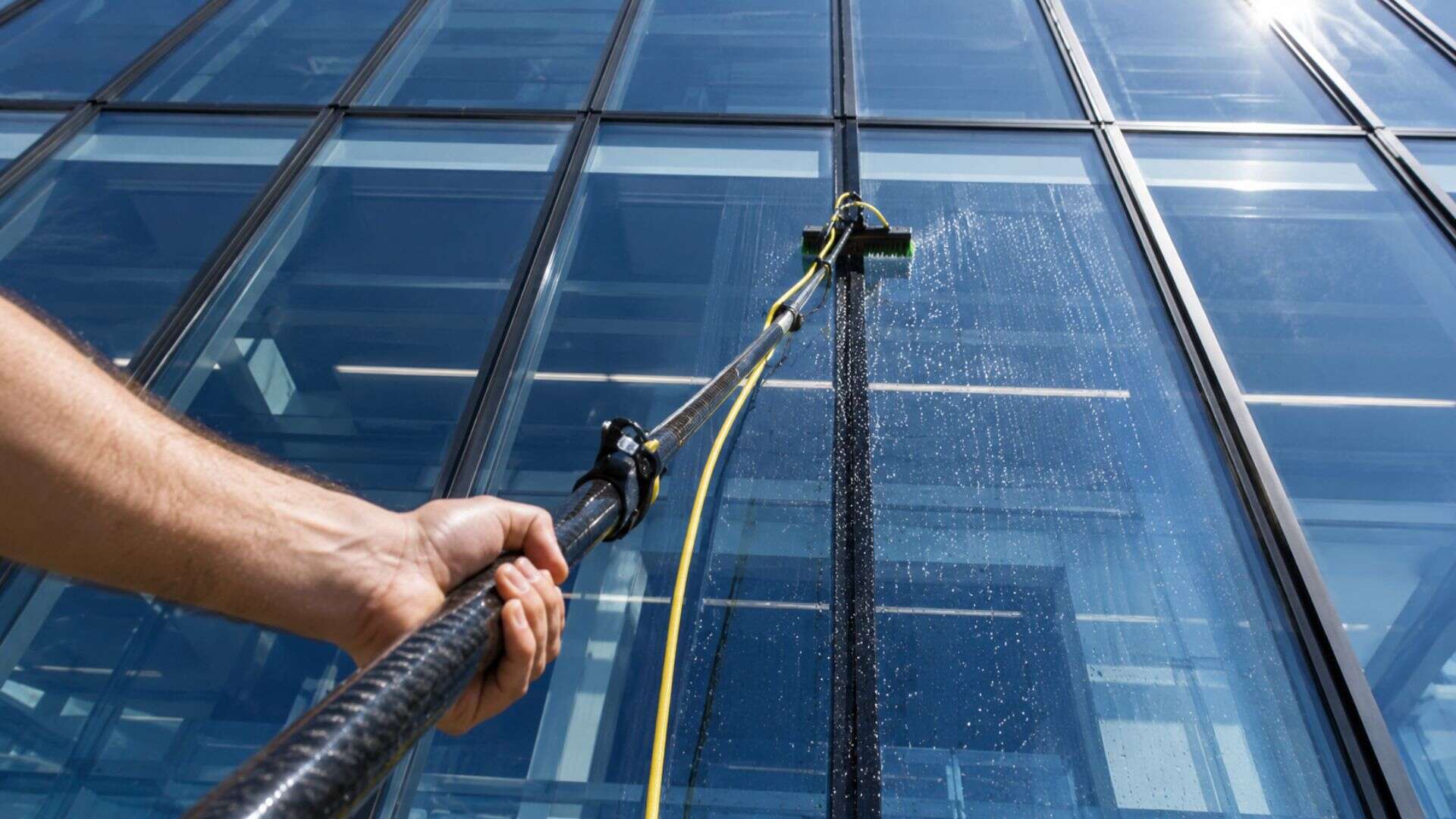
water. The cleaning itself is then carried out using specialized equipment and
working systems adapted to the type of façade and building characteristics.
The glass surfaces are then thoroughly rinsed
using the purified water in order to remove dust, dirt, water marks, and
accumulated residue in a more uniform and precise manner.
When reverse osmosis window cleaning is
performed professionally and adapted correctly to the building, it is possible
to achieve a particularly high finishing standard while preserving a uniform
appearance across the glass envelope.
An important characteristic of the process is
that the windows do not require manual drying or wiping after cleaning. Because
the water is highly purified, it dries naturally without leaving marks or
residue, due to the absence of minerals, salts, and other dissolved particles.
Reverse Osmosis vs. Conventional Cleaning
Methods
One of the primary differences between reverse
osmosis window cleaning and conventional cleaning methods is the quality of the
water being used. Traditional cleaning methods rely on standard water
containing minerals and natural deposits, whereas reverse osmosis cleaning uses
purified water that has undergone an advanced filtration process.
This difference mainly affects the final
finish quality and the appearance of water marks or residue after drying. In
addition, reverse osmosis cleaning enables more uniform cleaning results on
large glass envelopes and in buildings where exceptionally high visual
standards are required.
In certain structures, the method may also
improve operational efficiency while maintaining a consistent appearance over
time, particularly in buildings with extensive glass surfaces or complex
exterior systems.
Is Reverse Osmosis Suitable for High-Rise
Windows?
Yes. Reverse osmosis window cleaning is highly
suitable for high-rise buildings and complex glass envelopes, depending on
accessibility conditions and building characteristics.
In office towers and buildings with extensive
glass façades, the method enables more precise and uniform cleaning results
while integrating effectively into professional high-rise window cleaning
operations.
How Long Does Drying Take?
One of the key advantages of reverse osmosis
window cleaning is the use of purified water with extremely low mineral
content. As a result, fewer marks and residue appear on the glass surface after
drying compared to conventional cleaning methods.
Actual drying time varies according to weather
conditions, sun exposure, airflow, and façade type. However, in most cases, no
additional drying or finishing actions are required after the cleaning process
is completed.
Reverse Osmosis Window Cleaning as Part of
Building Envelope Maintenance
Reverse osmosis window cleaning is far more
than a routine cleaning process. It is an advanced operational method that
combines water filtration technology, specialized equipment, and full
adaptation to the building and exterior envelope characteristics.
When carried out professionally, the method
helps preserve a clean, uniform, and well-maintained glass envelope over time
while improving the overall appearance of the building. For office towers,
commercial properties, and buildings with large glass façades, it provides an
advanced solution that combines high finishing standards, professional
maintenance, and an exterior appearance that reflects the quality of the
property and its surrounding environment.